John Tortorella is rolling the dice with a new combination of forward lines, including a top-six that has never started a single game together. The new look lineup expected to begin Game 4 is as follows…
This gives us different options, and again, you guys run with it, right? We make a little change, and you guys run with it. You want all this information. There’s not much information. We changed it. We’re going to see how it works. -Tortorella
Having coached just 11 games with the Golden Knights, he’s searching for answers the same way many coaches do at the beginning of the year. He’s just being forced to do it before a pivotal game in a hostile building.
I’m still trying to feel my way through on some of the things. I don’t know what happened in the 82 game schedule. I don’t know the flows of the lines, of what line was working with one another. I’m relying on the other coaches, and those are the conversations we have. -Tortorella
The challenge for Vegas is that these lines have extremely limited experience playing together. The least familiar of the trios is the line of Reilly Smith, Mitch Marner, and Mark Stone. They played a total of 7:13 together in the regular season and were matched up for three shifts so far in this series. The combination of Ivan Barbashev, Jack Eichel, and Pavel Dorofeyev feels like something the Golden Knights have tried before, but they’ve played only 27:19 together this year.
In the first two games of the opening round series, the Golden Knights have scored six goals. Two came on the power play, one into an empty net, and the other three from Ivan Barbashev, Nic Dowd, and Colton Sissons. Vegas have just three goals at even strength in nearly 90 minutes of action, and none of them have been from their five leading goal scorers in the regular season.
To win the series, the Golden Knights are going to need their big guns to start producing more when the manpower is even. Jack Eichel, Mark Stone, Pavel Dorofeyev, and Tomas Hertl each have three shots and zero goals at 5-on-5 so far. Mitch Marner has registered just one shot on goal and only three shot attempts. The five most important offensive weapons have combined for a paltry 1.69 expected goals in the first two games, and nearly half of that has come on two of Hertl’s most dangerous chances.
We’re not just looking at one guy, we’re looking at the whole team. It’s not just one particular person, it’s our team concept, trying to be more consistent with our team concept. -John Tortorella
This isn’t a new phenomenon for the team. Eichel has one even-strength goal in his last 16 playoff games and none in his last seven. Hertl doesn’t have one in his last nine, nor does Marner in his last seven, or Stone in his last five. The youngest of the group, Dorofeyev, is still looking for his first career even-strength goal in his 12th playoff appearance in Game 3.
Sadly, the Olympics are over. Now that the United States has proven its supremacy over the rest of the world in the sport of hockey, it’s time to return to the task at hand here in Las Vegas, winning another Stanley Cup.
The Olympics offered Golden Knights fans somewhat of a new look at many of the best players on the roster. With different teammates, different coaches, and different roster sizes, many VGK standouts were placed in unfamiliar roles. The condensed tournament causes all sorts of sample size issues, but there’s always something to glean from hockey games of that magnitude.
Eight Golden Knights players participated in the tournament for five different nations. Their usage varied drastically.
Jack Eichel USA 🥇
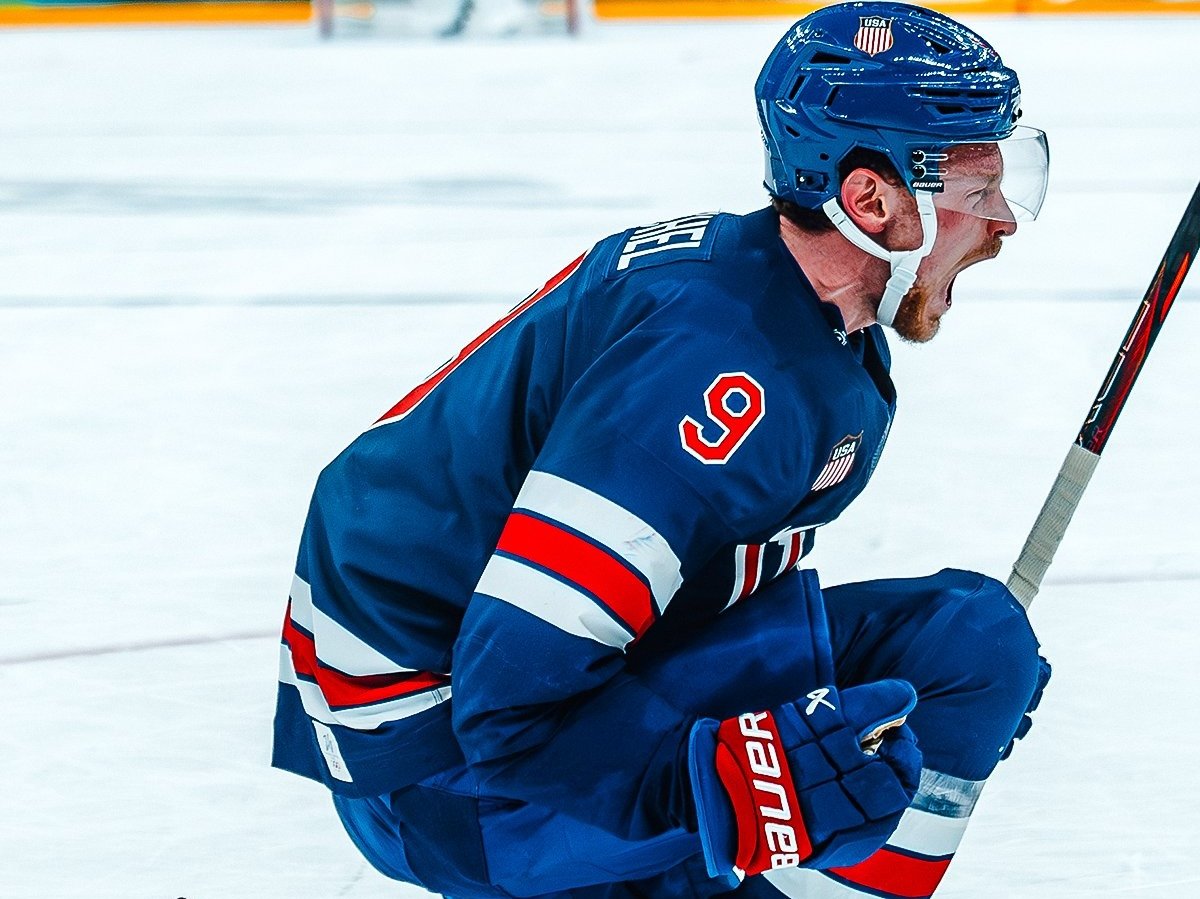
As they do in Vegas, Team USA relied heavily on Eichel. He led all forwards in ice time by more than six minutes, and he finished with the 3rd most ice time on the entire team. For the whole tournament, Eichel centered a line between the Tkachuk brothers, and their impact was felt in all three zones. Early in the tournament, the line dominated on the forecheck and created havoc around the front of the goal. But as the Games progressed into the medal rounds, the Tkachuk/Eichel/Tkachuk line started to take on a bit more defensive responsibility. Eichel was also the fulcrum of the USA power play, in his usual spot on the half wall, and he was typically on USA’s second group of penalty killers after J.T. Miller and Vincent Trocheck.
Eichel finished the Olympics with two goals and six points while landing 25 shots. He was a +5 and played 109:39 over six games for an average of 18:16 per game. He led the team in slot shots, was second in inner slot shots, and was clearly one of, if not the most, impactful forwards on the roster.
Mark Stone Canada 🥈
Vegas’ captain was placed on a line with Sidney Crosby and teammate Mitch Marner to open the Olympics. That line dominated pretty much every time over the boards, especially against the weaker competition in group play. Stone scored a tap-in goal on an unbelievable pass from Marner and ultimately scored two goals and four points in the tournament. He was used on the second power play unit in his usual spot near the goal line, and he was consistently used (often with Marner) as a penalty killer. Stone’s impact fell off a bit in the final two games after Crosby suffered an injury. In the gold medal match, Stone played just 14:53, landed just one shot on goal, and was the least noticeable of any of his games during the Olympics.
It won’t come as a secret to any Golden Knights fan that this year’s team has spent a lot of time behind on the scoreboard. To be exact, Vegas has been behind for 1,349 minutes and 12 seconds in 57 games. That’s the 5th most in the league, and they are one of just two teams in the Top 10 currently in playoff position (Anaheim).
VGK have come back to win 13 times, including eight times in the 3rd period, tied for the league lead.
It feels like the team as a whole turns it up when they are behind, but the individual numbers tell a bit of a different story.
Pavel Dorofeyev leads the NHL with a whopping 18 goals when his team is trailing. That’s five goals ahead of the next closest players, who are Connor McDavid, Leon Draisaitl, Filip Forsberg, and Morgan Geekie. Dorofeyev is tied for 21st in the league with 26 goals, yet leads the league by FIVE goals when trailing.
75% of Dorofeyev’s goals have come with the Golden Knights down on the scoreboard. That’s a massive number compared to McDavid’s 38%, Geekie’s 41%, and Draisaitl’s 45%.
Even more unbelievable is that 11 of Dorofeyev’s 18 goals when trailing have been on the power play, and another two came with VGK’s goalie pulled. That means an insane 50%, exactly half, of Dorofeyev’s goals this season have come with the Golden Knights down and with a man advantage. That situation accounts for just 12.3% of Dorofeyev’s total minute load as he’s scored 13 goals in 123 minutes when trailing and up at least one man, while playing a total of 999 minutes.
He’s not the only one, though.
Mitch Marner has scored 7 goals and amassed a whopping 30 points in 467 minutes with VGK behind. That’s 44% of his goals and 52% of his points in 40% of game time.
Tomas Hertl has four goals and six points in 28:40 with the VGK net empty. That’s a rate 8.37 goals and 12.56 points per 60 minutes. Or, if you factor it by Hertl’s average time on ice per game this year (17:26), he would have 2.43 goals and 3.65 points per game if he kept up his 6-on-5 pace.
Mark Stone and Hertl are each in the Top 10 in points while trailing and Jack Eichel is 6th in assists. Meanwhile, when the Golden Knights are ahead, they have just two players in the Top 50 in goals and two in the Top 30 in points.
VGK’s best players have been driving the bus when they are chasing deficits. Dorofeyev has lapped the field in scoring goals, while Marner, Stone, Eichel, and Hertl have been lighting it up as the Golden Knights try to come back.
The 2026 Winter Olympics are here, and for the first time since the Golden Knights became a franchise, NHL players will participate for one of sports’ most coveted prizes. Here’s a little rundown of everything you need to know about the tournament and VGK’s participation.
Tournament Format
12 teams have been drawn into three groups of four.
Group A – Canada, Switzerland, Czechia, France Group B – Finland, Sweden, Slovakia, Italy Group C – USA, Germany, Latvia, Denmark
The winner of each group, along with the best 2nd place finisher, will automatically advance to the quarterfinals. The remaining eight teams will be ranked 5-12 based on position in the group, highest number of points, goal difference, number of goals scored, and 2020 IIHF ranking, in that order. These teams will play in the first round of the playoff with matchups of 5v12, 6v11, 7v10, and 8v9.
The four automatic qualifiers will be ranked 1-4 using the same criteria to determine who they will play in the quarterfinals. 1v8/9, 2v7/10, 3v6/11, 4v5/12.
In the semifinals, teams will be reseeded so that the highest remaining team plays the lowest and the middle two play each other.
The highest-seeded team is always designated as the home team.
The tournament uses a three-point system. 3 points = Regulation win 2 points = Overtime win 1 point = Overtime loss 0 points = Regulation loss
Group stage games that end tied will go to a 5-minute 3-on-3 followed by a shootout. Playoff games prior to the gold medal match, will go to a 10-minute 3-on-3 followed by a shootout. And the gold medal match is 3-on-3 until a goal is scored.
The Golden Knights found themselves in a familiar place last night, chasing a lead late in the game. After a called-back tying goal, it was starting to look like it just wasn’t going to be the night. But, then the most dangerous weapon the Golden Knights have hopped over the boards and got to work.
It starts with the puck on Jack Eichel’s stick in or near the circle to the goalie’s right. His unique ability to maintain possession of the puck in traffic allows him to assess the options set up around him. Whether it’s on the power play, or in the late game 6-on-5 situation, the options remain the same.
To his left, there’s Mark Stone, standing on the goal line with his big body and elite stick facing the play.
To his right is Mitch Marner, with the ability to quickly move the puck or use his figure skating-like movement to attack the middle.
Directly in front of him is Tomas Hertl, a massive man who cannot be pushed out of the most dangerous spot on a hockey rink.
And finally, all the way across the ice, there’s Pavel Dorofeyev and his innate ability to fire pucks into the goal on the man-advantage, waiting for his moment.
There are a lot of different weapons and that’s what makes a power play successful. You need guys to understand their roles, but also that no matter where the puck goes there’s an ability to finish a play and I think that’s the beauty of this power-play. -Bruce Cassidy
There was no better example of it than with the clock bleeding away late in what felt like the biggest game of the year. First, Eichel passed it up to Marner. Recognizing a Leafs defender was without a stick, Marner gave it right back. So, Eichel held it, and eventually moved it to Stone. The defense collapsed towards the goal, and the captain gave it back to Eichel. On to option three. Eichel shuffled his feet as if he was going to unleash one of his slingshot-like wrist shots, opening the passing lane into Hertl. He dropped off a soft little feed, and the big guy in the middle spun it on goal in one motion.
It’s the unselfishness of the group. They know it, ‘Okay, well maybe it won’t be my night because they’re overplaying me, but someone else is going to have a night,’ and I think that’s led to a lot of success. -Cassidy
With seven seconds left on the clock, the Golden Knights had tied the game, finally, after being down by two goals on four separate occasions. It was their 5th goal of the night and 3rd coming with their five forward group on the ice (Theodore was out there too in the 6-on-5 situation for the last one).
This year’s team is still a work in progress at 5-on-5. They boast just the 15th most goals with both teams at full strength, and they’ve actually been outscored by a single goal following last night’s game. Being even, or close, is good enough though, because of the weaponry and the setup when they have an extra man.
It helped rescue a meaningful game against Toronto, it’s the biggest reason they currently sit in 1st place by four points with games in hand, and it’s why no matter what the scoreboard says at any moment, they’re never out of a game.
Over the past few seasons, since the Golden Knights won the Stanley Cup, there’s been quite a bit of turnover in the roster. Leaders like Alex Pietrangelo, Jonathan Marchessault, and Alec Martinez have moved on and have been replaced by the likes of Mitch Marner, Tomas Hertl, and Noah Hanifin.
Having won the division last year and currently sitting atop the Pacific once again, there’s no doubt that the hockey skill has continued to translate for the current group. However, there’s one area the coach says has been noticeably different.
It’s a good bench but it’s quiet at times. So, some of the emotion has to come from myself. Sometimes that’s fine and other times it’s not so fine. It’s easier if players are bringing it. Some days we miss some chatter there. -Cassidy
Looking at the names that have left compared to the ones that have come in, it’s not surprising at all that the bench is a lot quieter. Marchessault, Pietrangelo, and Martinez all had major voices off the ice, but even players like Logan Thompson, Paul Cotter, Nic Hague, William Carrier, and if we go back far enough, Ryan Reaves, many of the most boisterous players in franchise history have departed.
For a while there, the Golden Knights were widely known as one of the loudest teams, and there was constantly chatter back and forth between the benches. That seemingly isn’t the case with this team. Instead, they act differently towards each other.
They are very supportive. If something is said then they’ll pick up their teammate right away. If a coach challenges someone or something happens on the ice that doesn’t go their way then they’ll be the first to pick that guy up. So, I like that part of our bench, just sometimes it could be a little more vocal. -Cassidy
Oddly, you can almost feel it while watching the games as a fan. Until something significant like a big hit or an after-whistle scrum occurs, the games hum along without a ton of outward emotion.
It’s hard to say how much chatter on the bench will impact the team positively or negatively. It’s just another item to keep an eye on as the roster continues to transition.